
Antique Maps of Bath
You might also be interested in the following: Home | Antique City Maps | Somerset Antique Maps
Explore our collection of antique maps of Bath, including original 18th and 19th century town plans, city maps and historical maps of Bath and the surrounding area. The collection includes scarce examples by Thomas Moule, Andrew Dury, Robert K. Dawson, Pieter Meijer, W. Gingell and other cartographers and publishers.
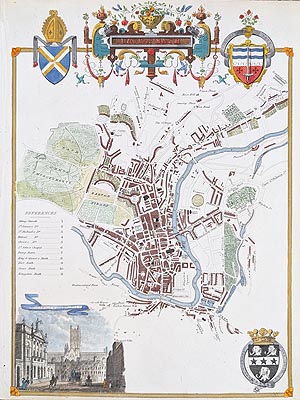
A decorative 19th-century map of Bath by Thomas Moule
circa 1836-50
£145.00
View map

Bath from the Ordnance Survey with text
Robert K. Dawson Lieut. R.E.
1837
£59.00
View map


18th-century plan of Bath and its suburbs by Andrew Dury
c.1764-1766
£245.00 scarce
View map

19th-century plan of Bath by Robert K. Dawson
C.1831
£59.00
View map

18th-century map of Bath by Pieter Meijer
c.1763
£255.00 very scarce
View map

Plan of Bath was produced by W. Gingell for Meyler's Bath Guide
1845-50
£225.00 scarce
View map

Early 19th-century plan of Bath by Savage and Meyler
1803
£495.00 very scarce
View map
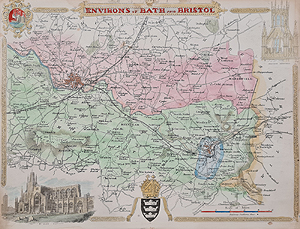
Mid 19th century Thomas Moule Map of Bristol and Bath
c. 1840
£68.00
View map
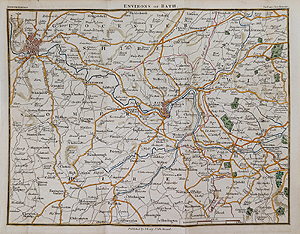
Environs of Bath
John Cary
1819
£75.00

Bath - Aquae Solis
William Stukeley
July 1723
SOLD

19th-century map of Bath by Rapkin and Tallis
C.1851
SOLD

A New Plan of the City of Bath
Cruttwell
1788
SOLD

An Accurate Plan of the City of Bath
W. Hibbart
May 1776
SOLD
Antique and Historical Maps of Bath
Explore our collection of antique maps of Bath, including original 18th and 19th century town plans, city maps and historical maps of Bath and the surrounding area. The collection includes scarce examples by Thomas Moule, Andrew Dury, Robert K. Dawson, Pieter Meijer, W. Gingell and other cartographers and publishers.
Each map includes details of its date, mapmaker and availability. Click an image or title below to view the full description and purchase details.
Historic Maps of Bath and the Development of the City
Bath has an unusually rich history as a mapped city. Its Roman origins, medieval street pattern and later development as one of England's leading Georgian spa resorts are reflected in maps produced over several centuries. Historic maps allow the changing shape of the city to be studied in a way that modern maps cannot reproduce.
During the 18th century Bath expanded rapidly as its reputation as a fashionable spa destination grew. New streets, squares, terraces and crescents were developed around the older town, creating much of the architectural character associated with Bath today. Contemporary town plans can show these developments alongside earlier streets and buildings.
The city's expansion continued during the 19th century. Later maps show the growth of suburbs and changing roads around the historic centre, including development towards Bathwick and other areas surrounding the River Avon. Comparing maps from different dates can therefore reveal how individual streets, buildings and neighbourhoods changed over time.
From Barclay's English Dictionary: 'BATH, a city of Somersetshire, famous from the times of the Romans for its hot springs. They are not only used as baths, but generally as medicine, and great benefits from them in gouty, paralytic, bilious and a variety of other cases. Bath is a place of such general resort, that it seems like a great national hospital; it is so far, however, from being a house of mourning, that it exceeds every other part of England in amusements and dissipation. It is laid out in squares, circuses, crescents, terraces &c. these are constructed of white free-stone, which abounds here, and are executed in an excellent style of architecture. It is seated on the River Avon; but, in its later improvements, the buildings, rising one range above another, have nearly reached the summit of the hill, on the declivity of which it stands. The principle season for the waters are spring and autumn;and, besides the great infirmary, here are several other hospitals and alms-houses, for the relief and support of indigent patients. Considerable manufactures of cloth are carried on or near Bath. It is 12 miles E.S.E. of Bristol and 107 W. of London. Market on a Saturday. Pop. 38,063.'
Bath Town Plans and City Maps
Historic town plans of Bath are particularly useful for studying the layout of the city before modern development transformed its surroundings. Detailed plans can show individual streets, buildings, gardens, squares and other features that are no longer visible or have subsequently changed, as well as detailing paliamentary boundaries.
Earlier plans are especially valuable for understanding the expansion of Georgian Bath. Later 19th century maps show the continuing growth of the city and its suburbs. For collectors and local historians, these maps offer both historical information and attractive examples of antique cartography.
Mapmakers of Bath
The antique maps in this collection were produced by a range of cartographers, surveyors and publishers. Their maps differ in both purpose and style, from detailed plans of the city and its suburbs to decorative maps produced for books, guides and travellers.
Thomas Moule
Thomas Moule maps are well known for their decorative depiction of the British counties and towns. His maps often combine geographical information with attractive engraved detail, coats of arms and views or vignettes of important buildings. His map of Bath is a particularly decorative example of a 19th-century town map.
Andrew Dury
Andrew Dury was an important 18th-century map publisher and cartographer. His detailed plan of Bath and its suburbs provides an earlier view of the city during the period when Bath was developing rapidly as a fashionable Georgian spa.
Robert K. Dawson
Robert K. Dawson produced detailed surveys associated with the Ordnance Survey. His maps of Bath provide a useful contrast with the more decorative town plans of earlier publishers and record the city with increasing topographical detail. His maps and plans of Bath indicate the political, parliamentary boundaries.
Other Bath mapmakers
The collection also includes maps by Pieter Meijer, W. Gingell, Savage and Meyler and other publishers. Together these maps provide views of Bath across different periods and illustrate the changing appearance of the city.
Buying Antique Maps of Bath
Our Bath maps are original historical maps and town plans dating from different periods. Each individual listing gives the mapmaker, approximate or publication date, price and availability. Please click through to an individual map for full details.
If the map you are looking for has already sold, please contact us as we may be able to help locate another historical map of Bath or a related map of Somerset.
Frequently Asked Questions About Antique Maps of Bath
What dates do your antique maps of Bath cover?
Our Bath collection includes maps dating from the 18th, 19th and early 20th centuries, with individual listings giving the estimated or publication date where known.
Are these original antique maps?
The individual listings describe the nature and condition of each map. Please see the full description of the individual item for details of publication, colouring, condition and other features.
Who made the antique maps of Bath?
Our collection includes maps by Thomas Moule, Andrew Dury, Robert K. Dawson, Pieter Meijer, W. Gingell, Savage and Meyler and other historical cartographers and publishers.
Do you sell old maps of Bath?
Yes. Available antique maps of Bath are listed above with their individual prices and descriptions. Availability changes as maps are sold.
Can you help me find a particular old map of Bath?
If the map you are looking for has already sold, please email us . We may be able to help locate another historical map of Bath or a related map of Somerset.
Mon - Closed
Tues-Fri 10am-1.30pm, 2.30-5.30pm
Sat 10am-1.30pm
© Devonshire Fine Art
 Free UK Mainland Delivery*
9 Church Street
Modbury
Devon PL21 0QW. UK
01548 830872


